Last updated 14 August 2026. Factual overview; disputed dates omitted.
Casino floors did not invent chance. They packaged older tools — cubes, wheels, cards, pegs — under lamps. The four games here sit on that longer shelf.
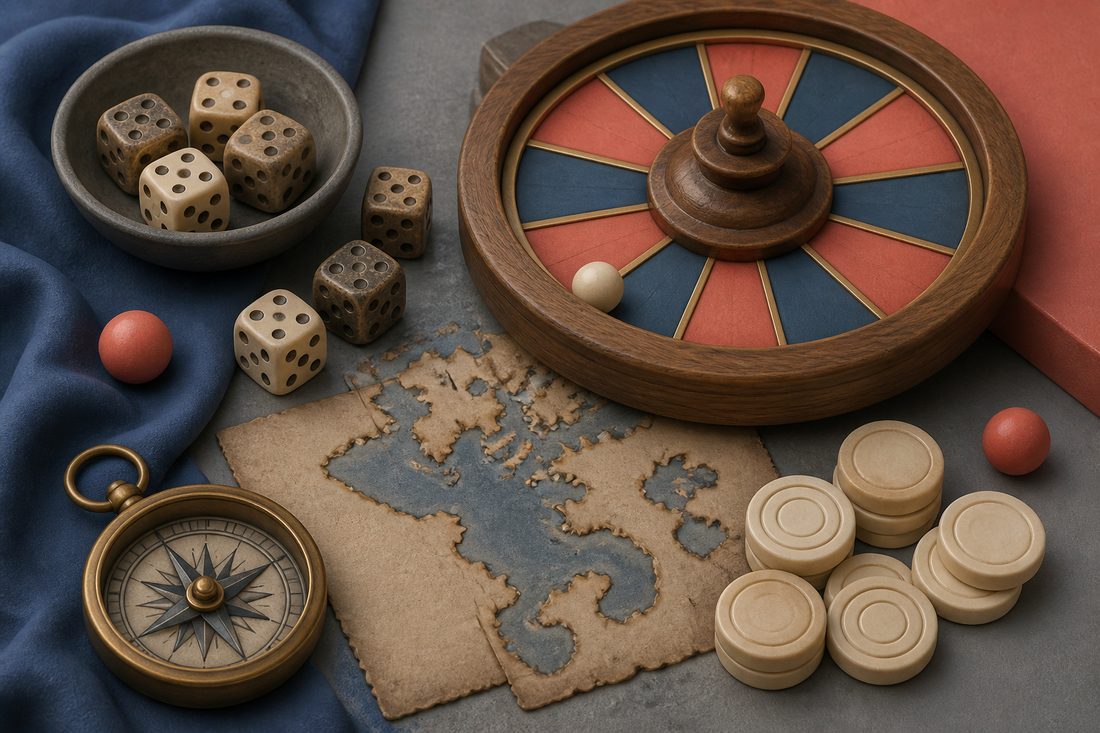
Dice, long before casinos
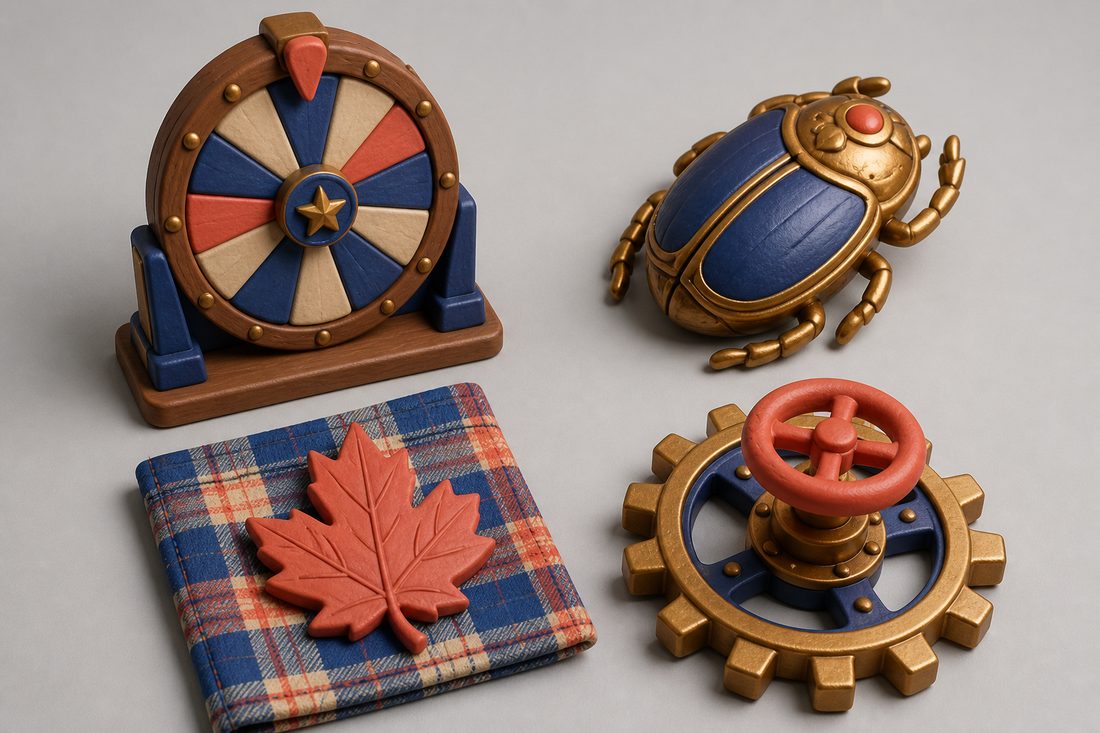
Cubic dice with pip marks appear in the archaeological record of the ancient Near East and Egypt. Knucklebones (astragali) are older still. A two-sided toss — our Scarab Streak — is the same idea cut down to one binary call, a method used for decisions in many cultures.
Wheels with numbered slices
European roulette settled into two main layouts: a French single-zero wheel (37 pockets) and an American double-zero wheel (38). The single-zero version is the one with the milder house edge. Carnival “money wheels” used a different logic: repeated low numbers on wide slices, rare high numbers on thin ones — the pattern Spur Wheel follows.
Cards and higher/lower
Playing cards reached Europe from the Islamic world in the 14th century, after earlier packs in China. Ranking a card and asking whether the next is above or below is among the simplest derived games; it needs a known order (here, Ace high) and a rule for ties. North Shore Hi-Lo uses a 52-card deck without replacement, which is the ordinary French-suited pack.
Peg boards and the binomial pile
Francis Galton described a quincunx — a board of pins that demonstrates the binomial distribution — in the late 19th century. Discs that bounce left or right with equal chance collect in the centre. Valve Drop is that classroom object with multipliers printed on the bins. Television and carnival peg-drops are later cousins; we do not borrow their brand names.
Single-zero vs double-zero
A fair 37-pocket wheel that pays 35 to 1 on a straight number has a house edge of 1/37, about 2.7%. Adding a second zero raises the edge. Spur Wheel is not roulette; it is a money wheel. The comparison is here because visitors often mix the two.
A fair coin has no memory
Independent tosses were already the working assumption of 17th-century probability (Pascal, Fermat, Huygens). Streaks happen. They do not make the opposite face “due.”
This page is a sketch, not a monograph. For rules of the live games, use each title’s panel. For how we handle sources, see the editorial policy.
This site stores a coin balance and a cookie-choice flag in your browser. No tracking pixels. See the cookie policy.